8.07.2014

What of the Potential?: Our Samuel moment at the border

Most of us have heard about the influx of children at the southern border of the U.S. Responses run the gamut; anything from the protesters who block the buses from entering their town to calls for compassion and an open door.

Of course, unaccompanied minors coming across the U.S. southern border is not a new problem, it's just that so many of them have been coming within such a short time span. Reports are that the vast majority are coming from violence- or poverty-stricken areas of Honduras, El Salvador and Guatemala.

In some admirable attempts to move to higher ground, bloggers like theologian Roger E. Olson have encouraged us to look at the underlying cause of this influx. In a post that purports to identify "the underlying problem no one seems to be talking about," he points to "our American affluence, including conspicuous consumption and luxury, promoted to the world via movies and television as the result of 'the American dream,' combined with our boast to be a 'nation of immigrants.'”

I think there's truth to this assertion of partial American responsibility, but he later suggests that the only solution to the problems in these Latin American countries is for the U.S. to go in with our resources and expertise and fix them. Given that the U.S. government and CIA have been doing some shady business in many Latin American countries for more than a century, I'm not sure we have the credibility, even if that were a prudent approach.

But even these "other" perspectives--those that seek to go above the partisan divide--still fall into a similar trap. All the commentaries I've read or heard, even the ones calling for compassion, fail to grant these immigrant children full human dignity by recognizing their potential.

It's more obvious coming from the right. Sometimes it seems that anything except for "send them back" is seen as irresponsible policy. Texas governor Rick Perry decided to send in the national guard, apparently unaware that these children are giving themselves up to the first adult they see, rendering such a strategy totally useless. Others are blaming President Obama and don't seem to be aware that current protocol comes from a law signed by George W. Bush. (Obama, who has deported more immigrants than any other U.S. president, actually wanted to amend the law to make it easier to deport the children). The anti-immigrant sentiment is so unbridled among some that a group of protesters in Arizona mistook a bus full of YMCA kids for one filled with immigrant children. One must wonder how immigrants have so egregiously stolen the life and liberty of these "real Americans."

Among others, there's something more subtle but no less ingrained. Though some of us may look upon immigrant children with compassion, we still subconsciously maintain a giver-recipient distinction. They are the poor, helpless kids who have come so that we can take care of them, quote the Bible, and feel like good Christians because we have served "the least of these" (Matthew 25:40). We have so much, they have so little. We give, they receive. We feel good and it gives us a sense of dignity.

What about their dignity? Have you ever noticed that we look at these immigrant children as somehow different from our own children? Our own children deserve the best. For the young people in our own families, churches, etc., we are willing to bust our butts to make sure they have what they need, and then some. Our own children get bedtime stories, pictures on the refrigerator, trips to Disney World, and adults asking them, "What do you want to be when you grow up?" Who is reading these kids a bedtime story? Whose refrigerator has space for their work?

Most importantly, who is asking them, "What do you want to be when you grow up?"

Perhaps you saw the viral video of an interview with a homeless man named Ronald Davis. He poignantly communicates the realities of poverty, like an inability to escape the cycle and, most notably, the lack of dignity. These immigrant children and families lack dignity, and that's something that we have the power to change.
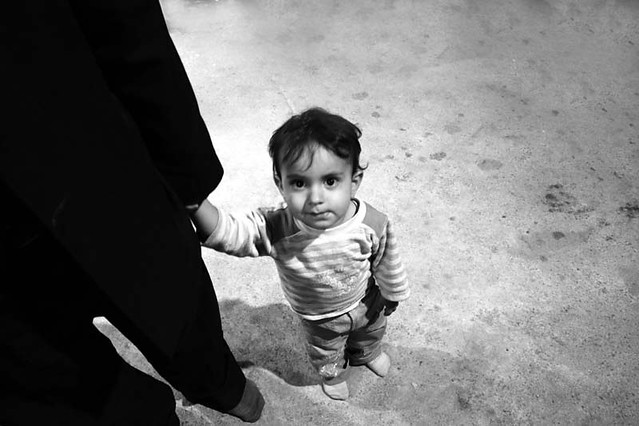
When I Grow Up, I wanna be... from Flickr via Wylio
© 2009 Mahmoud Eghtedari, Flickr | CC-BY-SA
What no one seems to be talking about is the potential of these children. Oh, we hear plenty about other kinds of potential. We hear about potential disease, potential cost, and potential criminal behavior. Is that really all we can see? Due to everything from the giver-recipient distinction to outright hatred and racism, we seem totally incapable of seeing immigrant children as having the same potential that our own children do. What if there was a future doctor on that bus you blocked from entering your town? What if there's a future chef or a nutritionist in that child that you only see as hungry and thirsty? How do we know that they have nothing to give us? Maybe they could teach us some humility. Maybe one of them might find a cure for cancer. Like any other children, their opportunities are limited to what we afford them. We could care for them and educate them and give them the opportunity to become contributing members of our society, or we can send them back to the hopeless life they left, and probable death.

Undocumented immigrants already contribute more than we think. According to Stephen Goss of the Social Security Administration, they pay about $12 billion into that system per year...a system many of them won't ever benefit from.

We have to be willing to invest in these children...spend time and energy now for the sake of a better future down the road. But recent public discourse and congressional budget battles have left me wondering if we even understand this concept. Think of it as a loan. When you loan money, your pockets are emptier at first, but through interest you may stand to get back more than you started with. Sure, sometimes you end up losing, but an unwillingness to invest is why the U.S. has a crumbling infrastructure and is quickly falling behind other countries in many categories. Anti-government and anti-taxation sentiments have left us with enough nuclear weapons to destroy the solar system but electrical grids that can't withstand a typical thunderstorm.

Garrison Keillor once said, "Nothing you do for children is ever wasted." When we see those pictures of children coming across the border or being crammed into makeshift facilities, my prayer is that we will not be filled with hatred or even pity but with wonder at their potential. What could they give and contribute, both now and down the road? Why is it we assume they can't or won't? We are already a country full of accomplished immigrants.

The U.S. gives out something called an O-1 visa. It's given to immigrants who demonstrate "extraordinary ability in the sciences, arts, education, business, or athletics." We gave one to Justin Bieber, and he's already caused more trouble than most of these Latin American children would. We have a broken immigration system that prices most people out, even if they could manage to figure out the forms and requirements. Whenever people say something like, "They should just come here legally," they are revealing a lack of basic knowledge about what it takes to do so. It's not possible for most. You have to have connections, money, and time. Most desperate immigrants have none of those. If it were me, I'd sneak in too, especially for the sake of my children.

Precious few people know what is engraved on a bronze plaque inside our Statue of Liberty. It's a poem called "The New Colossus," written by Emma Lazarus. Here it is in full:
Not like the brazen giant of Greek fame,
With conquering limbs astride from land to land;
Here at our sea-washed, sunset gates shall stand
A mighty woman with a torch, whose flame
Is the imprisoned lightning, and her name
Mother of Exiles. From her beacon-hand
Glows world-wide welcome; her mild eyes command
The air-bridged harbor that twin cities frame.
"Keep, ancient lands, your storied pomp!" cries she
With silent lips. "Give me your tired, your poor,
Your huddled masses yearning to breathe free,
The wretched refuse of your teeming shore.
Send these, the homeless, tempest-tost to me,
I lift my lamp beside the golden door!"
Did you see that part near the middle? "Keep, ancient lands, your storied pomp!...Give me your tired, your poor..." According to this poem, the U.S. not only welcomes immigrants, but would rather have those who are currently hopeless and beaten up by life than those who come with fame, expectations, or entitlement. Lady Liberty might be onto something.

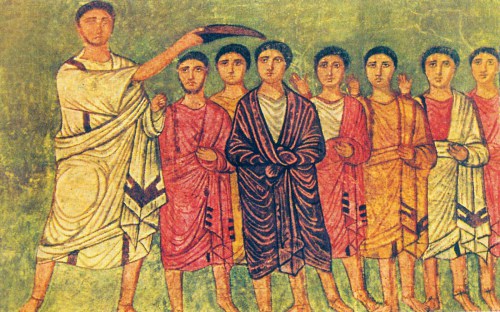
This is our Samuel moment at the border. In the Old Testament book named after him, Samuel is sent to Jesse's household to anoint God's chosen king. In the well-known story, David the shepherd boy is not even in the line-up. It seemed so unlikely that he would amount to anything that no one even considered it. But God said to Samuel, "The Lord does not look at the things people look at. People look at the outward appearance, but the Lord looks at the heart" (1 Sam 16:7).

Christian singer Ray Boltz once wrote a song inspired by this story: "When others see a shepherd boy,
God may see a king."

"They have diseases," some say. "They are a drain on our resources," some say. "They just want handouts," some say.

What if our ancestors had been turned away for the same reasons? What if, as we see only risk, God sees dreams waiting to come true?

7.18.2014

Prayer in a Theater and Bluegrass in a Sanctuary

I went to two worship services last Sunday. They included things like a theater, incense, icons, bluegrass, and popsicles. Stick around and I'll explain a little more.

This past weekend I was in Denver/Aurora for the 3rd of 4 research site visits during my sabbatical.1 I was working primarily with Mosaic Church of Aurora, a recent church plant in neglected areas of Original Aurora. I worshiped with them on Sunday morning, but while in the area, I also took the opportunity to visit an evening service of House for All Sinners and Saints, the ECLA church founded by the iconic, tattooed Lutheran minister Nadia Bolz-Weber (who was unfortunately not there due to being on sabbatical herself).

Besides the fact that I've enjoyed this summer's temporary break from my usual position up front in worship leadership, these two worship experiences demonstrate that worship in any form can be rich, and can serve to dispel a few myths about worship.

*****

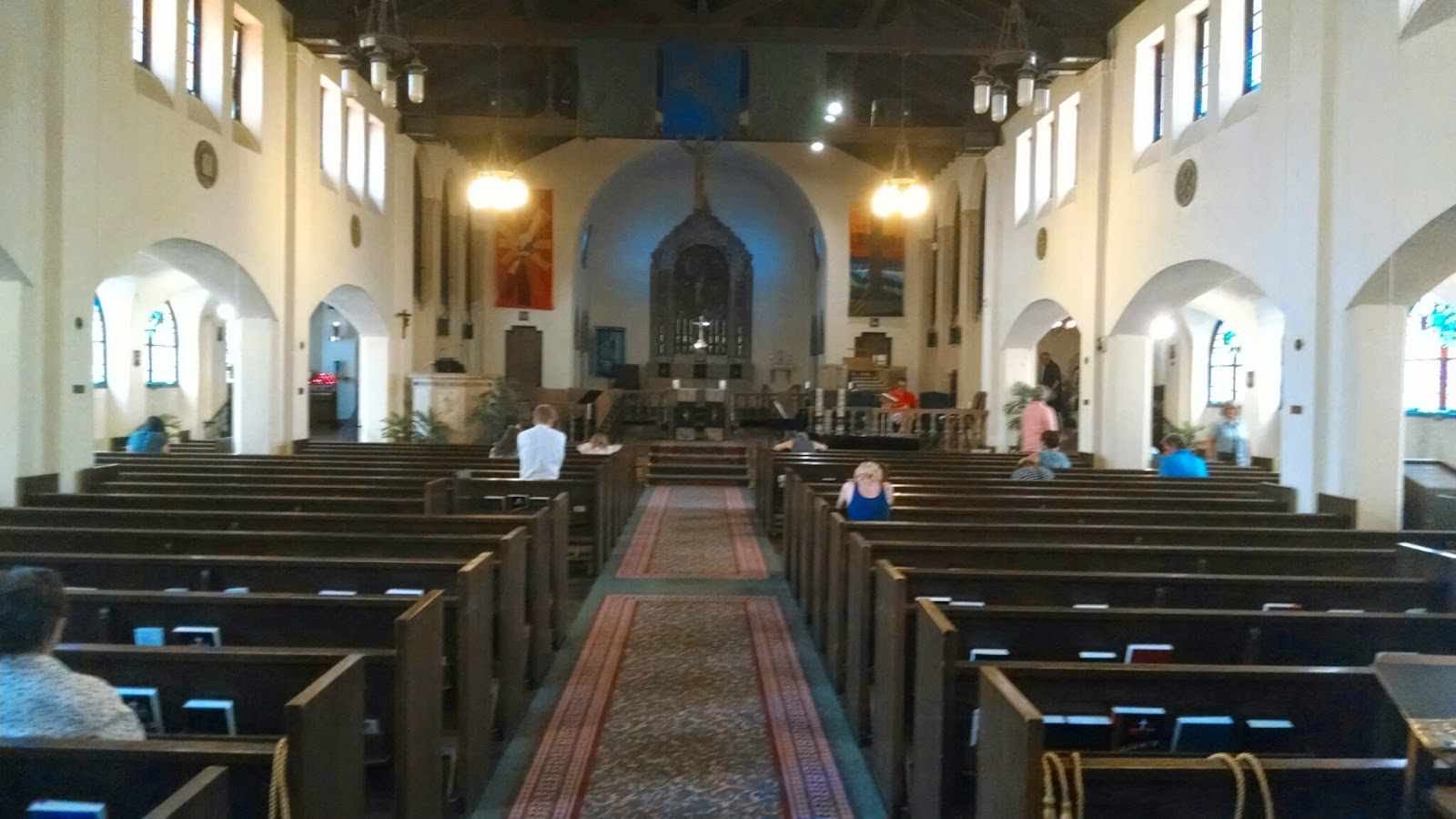
It was not a "normal" Sunday for either congregation. Mosaic's congregation is meeting in a small theater they were temporarily allowed to use. Their purchased facility is right across the street, but this picture shows why they're not using it right now. In partnership with The Fields Foundation (not related to me that I know of), and with the support of city leaders and contractors with whom they're good friends, they are making this currently gutted building into a community "Opportunity Center," in which they hope to worship and with which they hope to serve the immigrant community, the homeless, and children and families (among others).

There were 30-35 people there. The sound system consisted of one microphone. Also on stage were two chairs, the communion table, and an offering box. Their musician was out of town, so this service had no music except for Amazing Grace a cappella at the very end. Several of their dedicated homeless members were absent that day as well. If I had to do percentages, the service was about 50% prayer, 40% dialogue, and the remaining 10% would be communion at the end. Early in the service the pastor invited me up to talk about what I've been learning throughout my sabbatical, and we prayed for each other's ministries.

The pastor often invites someone up to have a dialogue about how God is working in his or her life. This Sunday, it was a woman named Stephanie, a Native American single mother who shared about how much this congregation means to her and how she was celebrating being 10 days sober. As she shared this and about her struggle with finding consistent work and making it through life, the love and support from the congregation was palpable. They cheered for her victories, shouted "we love you," and surrounded her with hugs and prayers.

Other parts of the prayer and dialogue were about the direction of the church and their hopes for transformation in this part of town. People shared their hopes, frustrations, and asked questions. One thing was clear to me: they were not there for a fantastic worship experience. They were there because they were compelled by the vision of the church and knew they were part of the work of God. I was reminded of Fuzz Kitto's short video about mission and worship in which he declares, "'Without mission, worship doesn't make sense. We're just coming together to be entertained."

*****

Sunday evening, it was bluegrass week at the House for All Sinners and Saints. As I walked into the old, historic Episcopal church, I heard a guitar, a mandolin, and a bass playing a combination of spirituals, old hymns, and folk songs. Some people were eating popsicles--an item they give out in the summer due to the lack of air conditioning. Given the national popularity of this congregation's pastor, the crowd was much smaller than I was expecting (roughly 60-70), although this was not their only service. I wouldn't be surprised if it is better attended when Nadia is there. The average age in the room couldn't have been much higher than 35. The service meets in a wooden-floor room about half the size of a regulation basketball court. On a table near the entrance was literature, Christian paintings, and an iPad set up to receive donations via credit card. Chairs are set up in a circle around a table that has a cross, candles, communion elements, and incense. Among the chairs was a colorful rug with toys on it where children are welcomed (no separate class or room for children). No one showed annoyance during the service when the children shrieked. 

Like Mosaic, the only piece of technology there was a microphone that was used by guest readers. House for All uses many of the ancient traditions of the church. All attendees were given a printed liturgy that has the readings, chants, and litanies for that day, following the Revised Common Lectionary. Some of the printed books are specially marked for those who are willing to lead part of the service (I volunteered to do the gospel reading). They rely heavily on participants in worship in this way (their website says they are "anti-excellence, pro-participation"). Worship began with a few songs, followed by the day's scripture readings. Between and during liturgical readings, short lines were sung in the bluegrass style (that are normally done more as ancient chants). The gospel reading was the Parable of the Sower (Matthew 13:1-9, 18-23), and one of the readings was a poem written by a second grader about planting and growing.

A Methodist minister who was filling in for Nadia gave the sermon on the Matthew text, in which he was very honest and open about the ways that he can be the different types of "infertile ground" for the "seeds of the word." After the sermon, there was "open time," something they always do. It's a time for personal reflection and prayer to be used however one pleases. Some suggested options were sitting in silence, walking down the hall to the full sanctuary and praying there, writing down prayer requests that were announced later, or taking part in a simple hands on activity related to the theme for the day, which on this day was a table with vases representing the different types of ground on which the seeds fall in the parable. Worshipers could take seeds and put them in these vases that had reflection questions like, "What rock of shallow joy keeps you from rooting yourself in God's grace?"

I made my way to sanctuary, which is an old and beautiful venue rich with symbols including paintings, holy water, candles, stained glass, and crosses. Most worshipers who had come in were kneeling in prayer. One young man went over to pray in a corner in the front that had a votive candle rack in front of an icon of Christ.

After 10 or 15 minutes we all returned for announcements, a few more songs and litanies, and finally communion (for which one could choose between real wine and grape juice). They declare each Sunday that their communion table is "open, without exception." As the pastor spoke the words of institution, he held his small child in his arms for part of it, and as he did so the child was excitedly reaching for the bread. I couldn't help but appreciate the image.

*****

Pastors and church goers alike can conceivably go most of their life without having to experience the anxiety of walking into a worship experience in which you don't know what's expected of you. It's a healthy thing for us to experience from time to time. Without experiencing things that are different, we slip into thinking that our way is normative. This is especially important when we consider the increasing numbers of young people who have never stepped foot inside a church. We often underestimate how important it is that people know what happens in our services. Even if this is not an actual reason we're seeing a return to liturgy in some churches, it might be one reason people appreciate it: there are no surprises. You can simply follow along and you're free to reflect on the meaning.

Also, in both of these churches, it was very obvious that they welcome everyone without exception. The diversity was refreshing. It has been said that people can tell, within the first 2 minutes or so, whether they will be welcome in a church. We communicate it with our words and actions, but we also communicate it in other ways without even knowing it, like the name of our church itself. People are broken, and we look for safe places. In our own churches, are we really "a house for all sinners and saints"? If so, how do we communicate it? Are we a family of believers who love each other and enter into each others' joys and sorrows, or are we separate families who are each coming for whatever the church has to offer, occasionally venturing into our normal cliques?

But here's the most important thing for me: both of these churches dispel the myth that engaging young people in worship is a matter of finding the right venue, music style, preacher, etc. The first church I visited didn't even have music, and the preaching at House for All was not polished. But plenty of young adults and children were present in both.

These churches represent something quite different from the "seeker sensitive" model of church in which we tone down the churchy stuff and use different music to make it as familiar to the rest of culture as possible. I got the feeling that these faith communities were not interested in apologizing for being a church with a 2000 year old history and a deep connection to those who have come before. Pastor Nadia, in a widely read post from a few months ago, wrote,
If in your congregation, regardless of size, prestige or property, if the Word is preached and the Eucharist shared and water poured and forgiveness of sins received, then congratulations, your congregation is a success. So when the numbers crunchers and church consultants say the church is dying…may I suggest that we only say this when we forget what the definition of church is.
But these churches also recognize that anything that is given to God can be used in worship. Creativity and art (not just music) are embraced as a way to connect with the divine. There is certainly something to be said about Leonard Sweet's acronym for effective worship: E.P.I.C. - Experiential, Participatory, Image Rich, and Connective.  Worship is experienced, not just heard; participated in, not just watched; based on images, the things we best remember; and connecting us to others around us, not just looking at the backs of their heads.

Think of the young child enthusiastically reaching for the bread. That's a good image--not just for the younger generations but all of us. We want to be connected to something meaningful, and we long for things like truth and love and grace. We want to be a part of something that is using our gifts to try to transform lives. For these churches, their worship is directly tied to their broader mission. Getting someone to a worship hour is important but not the end goal. They have a bigger vision for a specific community that they pray and talk and preach about in worship. You get the sense that you're going to miss out if you don't connect with them during the week.

In other words, these churches are missional, and that's what I found attractive about them. When you get right down to it, the intrinsic, often sub-conscious mission of today's struggling churches is to grow - more butts and in the seats and more dollars in the plate. It's an understandable reaction to decline, but that's not a very inspiring mission. I've never felt the urge to go be a warm body somewhere. But I have felt the urge to join in and participate with God's real, tangible, transformative work in the world. I am going to be interested in a church that is courageously entering its community, taking it literally when the scriptures say that God makes "all things new," and thirsting to be a part of that work. It's messy, but it's our calling.

To what is your church inviting people?


1 Thanks to my wonderful congregation who I've served for 8 years this August, I'm on a summer sabbatical. The research portion of my sabbatical is funded by the Pastoral Study Project grant from the Louisville Institute. I'm studying how churches are finding ways to engage in community ministry using the model of Asset Based Community Development

7.10.2014

Boesak to Baptists: Reconciliation is Not Pretty

"If we are not ready to live reconciliation as a revolutionary movement of our time, we should not speak of it."

That was South African anti-apartheid activist Allan Boesak's message to Baptists gathered in Atlanta on June 26, 2014 at a luncheon hosted by the New Baptist Covenant. It took place during the General Assembly of the Cooperative Baptist Fellowship.

Boesak is currently the Desmond Tutu Chair of Peace, Global Justice and Reconciliation Studies at Christian Theological Seminary and Butler University, and throughout his life has served in many positions of influence within South Africa and internationally. He is best known for his long-time involvement in the civil rights movement of South Africa and particularly the anti-apartheid struggle.

The New Baptist Covenant is an association of Baptists that is less than 10 years old. Citing Luke 4:18-19, it is focused on bringing Baptists together across differences and joining hands to carry out the work and ministry of justice and peace. Besides Boesak, the stage was occupied by leaders from both the Cooperative Baptist Fellowship and American Baptist Churches, USA.

Boesak began by saying that the New Baptist Covenant movement gives him hope. Though of the Dutch Reformed tradition himself, Boesak said that he is greatly encouraged by the existence and efforts of the group.

But he quickly went on to shatter any pleasant and comfortable notions surrounding the word "reconciliation." "The Jesus of reconciliation is not the Jesus the church has been preaching because that Jesus has kept us comfortable," he said.

Boesak told the group that reconciliation requires an uncomfortable encounter, not only with the other person but also with the self.

Boesak also said, "Reconciliation is not possible without a shift in power and equality."

Segregated Entrance, Apartheid Museum, Johannesburg from Flickr via Wylio
© 2013 Rob, Flickr | CC-BY | via Wylio
He knows this all too well. His friend Nelson Mandela was elected as South Africa's first president in 1994 after a decades-long fight to end apartheid. Mandela and his people, the black majority in South Africa, had been oppressed in every way possible. Mandela's autobiography details the relentless way in which the white government stacked the cards against the black people at every possible opportunity, systematically taking away all their rights and opportunities. They were imprisoned for pretentious reasons, sometimes in conditions unbecoming of animals. Mandela himself spent 27 years behind bars.

When Mandela came to power, he faced pressure from his black colleagues and friends to play payback. They wanted revenge (or, as some in the U.S. call it, "justice"). But he chose the path of reconciliation. He set up the Truth and Reconciliation Commission and did something almost unheard of: he fully included his former oppressors in the healing process and the formation of a new democratic government.

Boesak saw this firsthand. He saw how power and position could be used as a balm or an axe, and he saw the sheer grace of God it took to come face to face with former oppressors and say, against all emotional instincts, "Let's be on the same side now."

I think of the victim-offender mediation programs that are gaining popularity around the United States. It's a process in which trained mediators facilitate conversation and healing between, say, a murderer and a close family member of the victim. Such a thing doesn't even sound warm and fuzzy, and as those who are close to the process can tell you, it's not.

So whether it be something like that here at home or the Truth and Reconciliation Commission of South Africa, the work of reconciliation, to which the apostle Paul says God has called us (2 Cor 5:18-19), can be grueling. It can and must involve coming to terms with one's self, letting go of what one can't control, and lots of listening. The offender/oppressor must be willing to hear the anger, grief, etc. of the victim, and the victim must be ready to hear the offender's story to start to see him/her as a person. If it's not gut-wrenching, it's not reconciliation. This was that of which Boesak was speaking in front of that room of Baptists.

In fact, Boesak said that his highest hopes for South Africa have not been realized because of an insufficient commitment to true reconciliation. "The gap between rich and poor is bigger than ever in South Africa because we did not take reconciliation seriously enough."

For Boesak, it was a choice to try to live as South Africans, not the other labels that were used to divide and disenfranchise. "The choice of retribution or reconciliation was in every respect," he said, "a choice between chaos or community." This kind of unity might sound nice, but it's also historically rare; the reason being that it does not allow us to maintain our clear and self-vindicating categories. It's more ambiguous, it requires more tolerance for diversity, and, as Amy Butler recently wrote, it requires recognizing how quickly we ourselves can join "the camp of the litmus-testers."
It can happen so quickly, so innocently; you might not even notice you’ve crossed the line until you find yourself, like me, nursing indignant self-righteousness, so determined you’re right that your ability to love in the way of Jesus becomes severely hobbled. It’s the great irony: just when you think you know the lay of the land, the gospel invites you to love harder.
This is why Boesak issued a stern warning against selective justice and reconciliation. "We dare not claim God for one kind of justice but turn our back on that same God for another group," he said.

What a far cry reconciliation is from realities we witness today at home and abroad. I can think of too many examples of people funding and fighting for the exact opposite of this. Instead of reconciliation with those who have wronged us or we have wronged, we see battle lines drawn between people who are supposed to be on the same side. I can see why Boesak saw this message to be so important. It seems to be a disease here in the U.S. From personal relationships to religious groups and political parties to ethnic groups, time and again we find ourselves doing division instead of multiplication; creating more litmus tests and drawing more boundaries.

"If we are not ready to live reconciliation as a revolutionary movement of our time, we should not speak of it," Boesak said. I pray we would be found courageous for the task.